Seeing the City: Football and Community
By Emeritus Professor Tom Woodhouse of the University of Bradford
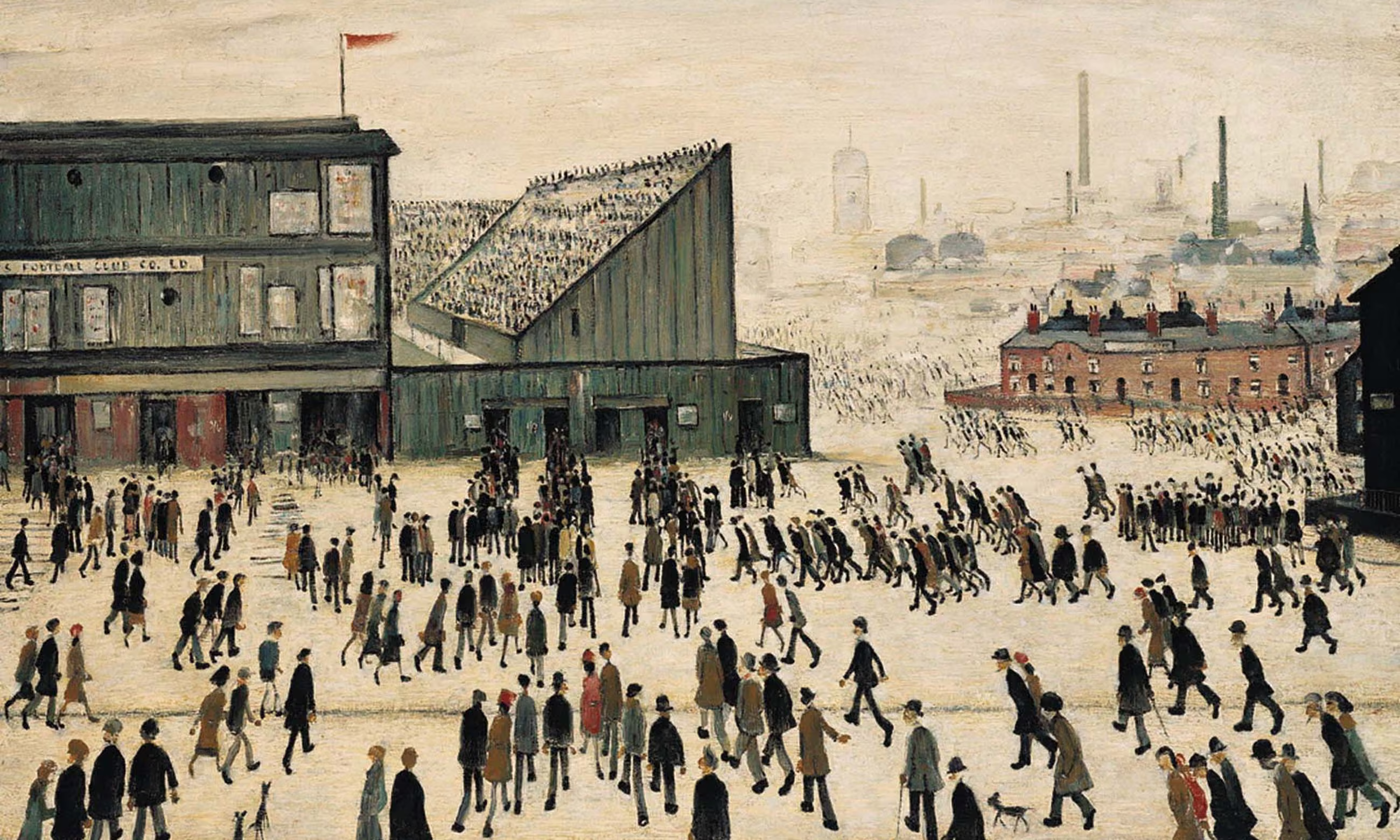
LS Lowry Going to the Match – Burnden Park Burnley 1953
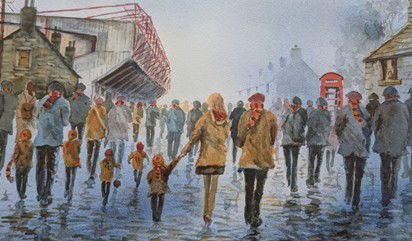
Andrew Storrie See the City. Fans going to Valley Parade / University of Bradford Stadium
Football clubs are one of the most important institutions through which people can express both personal and collective identity. Given this recognition of the significance of football for community identity. When traditional working class communities began to break down under the pressures of de-industrialisation from the 1970s onwards, there were concerns about outbreaks of urban disorder, political extremism and racism. In response, in 1986 the Professional Footballerrs Association and the Football League launched a pilot scheme called Football in the Community (FITC). This defined a strategy to de-escalate tensions through social cohesion and social inclusion projects. Initially, twelve clubs based in the north of England joined the initiative. By the 1990s all of the 92 clubs affiliated to the EFL and the EPL had established FITC centres, (now called Football Foundations or Club Community Organisations).
Over the three-year period 2022-2025 the Premier League committed £1.6 billion to support community activity, social inclusion and community education, employing over 6,200 people in CCO charities to deliver their programmes, generating £8 billion to the UK economy and supporting 90,000 jobs. Similar impacts are recorded by the EFL Trust which, led by Liam Scully, (Chairman of the Trust and CEO of Lincoln City), works to ensure that all the 72 affiliated clubs of the EFL remain deeply and dynamically embedded in their communities. Another indication of the community support provided by football clubs is shown in the social value generated. In the 2023-2024 season, for example, EFL clubs generated £1.24 billion in social value, defined as the savings in public spending on health, well-being, education, employment and other areas of public welfare.
In 2022 the United Nations launched Football for the Goals, a platform for the global football community to engage with UN’s 2030 Agenda for Sustainable Development, adopted by all member states in 2015, which identified 17 world Sustainable Development Goals (SDGs). There are many ways in which football clubs, with the resources and the unparalleled social capital they have in their communities, can have an impact on local SDG activities. My own survey of the 92 club foundations in the four English football leagues, conducted over the period 2022-2025, shows a strong engagement with a wide variety of programmes and projects that support the objectives of the UN’s Sustainable Development Goals, especially SDG 3 (Health and Wellbeing); SDG 4 (Quality Education); SDG 5 (Gender Equality); SDG 8 (Decent Work); SDG 11 (Sustainable Cities and Communities); SDG 13 (Climate Action); and SDG 16 (Peace Justice and Strong Institutions).
In this digital age and knowledge-based age, football has shown an energy to evolve and develop its ability to lead and shape positive and inclusive change not only on the pitch but also in the communities it serves. As one of many examples, the University of Bradford signed a four-year sponsorship deal with Bradford City in 2022. This includes the University’s logo appearing on the back of the team’s home, away and alternative kits, and Valley Parade being re-named as the University of Bradford Stadium. This partnership has resulted in the ‘Stories from Valley Parade’ project, in which academics have created a digital copy of the University of Bradford Stadium, which people can explore through VR. The project forms part of the University’s Bradford 2025 programme, celebrating the sense of pride and belonging that being a football fan brings to people in the city, and provides a new way of recording cultural and community heritage as fans tell their own stories, digitally recorded and preserved in the project's 3D data collection. Football continues to evolve not only as a compelling spectacle on the pitch but importantly as a social and cultural community asset, making an impact both at the UN Sustainable Goals level and deeply embedded within local communities though the work of its foundations.
Related stories on our blog:
Wayne Jacobs Bradford City and One in a Million Charity
Lincoln City and Bradford City Bringing Communities Together