World Cup x Peace, by the Institute for Economics and Peace
The World Cup (and football in general) is a stage for global history and geopolitics. This year, especially, hosting 48 nations, it is the largest World Cup to date. But it is also a time when geopolitical unrest is at its highest level in 50 years. Knowing this, the Institute for Economics and Peace (IEP), who produces the standard for peace data analytics, has turned its methodology to the connection between football and peace in a groundbreaking interactive website.
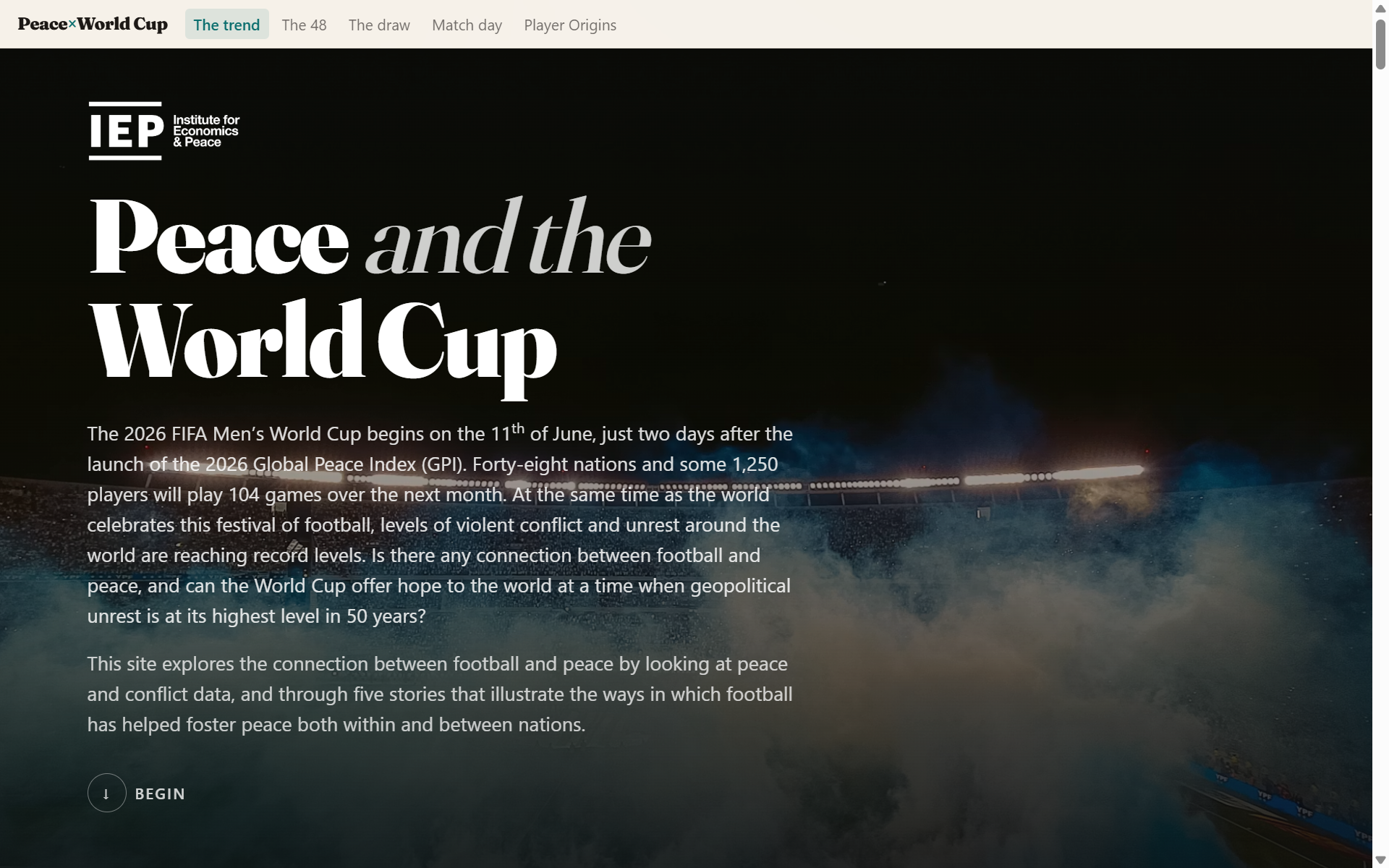
Source: World Cup x Peace, Institute for Economics and Peace
The 2026 Global Peace Index (GPI) launched on June 9th, two days before the kick-off in the Azteca Stadium in Mexico City. The report “reveals a world struggling with the economic consequences of a record-high number of conflicts that are increasingly interconnected and difficult to resolve”2.
Source: Global Peace Index - Institute for Economics & Peace
It is the lowest level of global peacefulness since the inception of the Index in 2007. In fact, since the 2014 World Cup in Brazil, violent conflict, political instability, and geopolitical unrest have generated a continuing decline in peace1.
The Index also points to a record in global military expenditure, while successful diplomacy for conflict prevention could have benefitted the global economy. While violence cost $21.8 trillion in 20253, imagine how countries and people could have gained from that kind of investment in other areas of life - such as sport and education.
So, if peacefulness is related to prosperity, do more peaceful countries play better football?
IEP answers this question by exploring the correlation between the FIFA rank and measures of positive peace (Positive Peace Index): “Countries with better institutions, stronger governance, lower corruption, and stronger economic growth are likely to have a higher FIFA ranking than those that don’t.”1
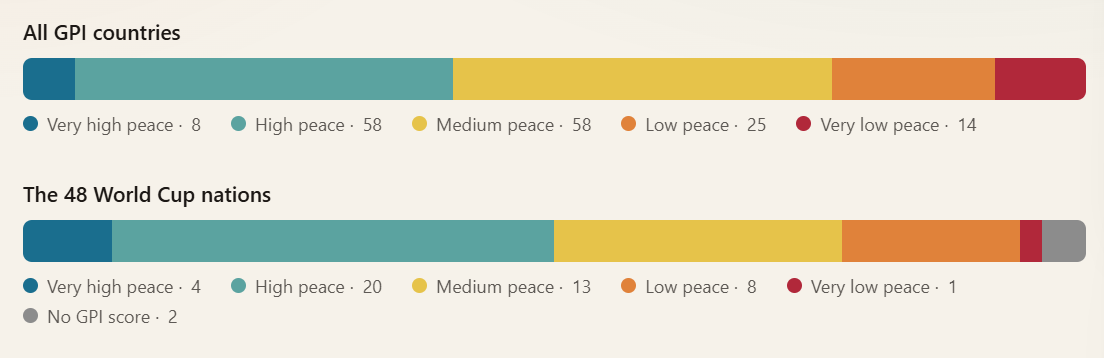
The World Cup is a stage of global history and geopolitics. The level of peacefulness of the 48 nations in the tournament mirrors that of the world, with half of them ranked as 'very high peace' or 'high peace'.
Source: World Cup x Peace, Institute for Economics and Peace
The draw of the matches has allowed for some interesting encounters, such as Portugal (ranked 7th in the GPI) against the DRC (ranked 161st in the GPI). The IEP provides an interactive tool to see who would win in peacefulness, safety and security, ongoing conflict and militarisation through all of the group games.
And does football have the potential to resolve and end conflicts?
IEP highlights the role of Didier Drogba in halting the civil war in Cote d'Ivoire (which you can also read on our blog), and also hints to the US-Iran current conflict by remembering the 1998 match between the two nations. It is perhaps too ambitious to wonder if football could lead to a solution in the political field.
Actually, concerns are at a high regarding human rights and sport equity4 given the difficulties for Iran in securing visas for their whole staff or even guaranteeing the safety of their squad in the main host country. Nonetheless, there is a chance the two countries meet in the knockout stages.
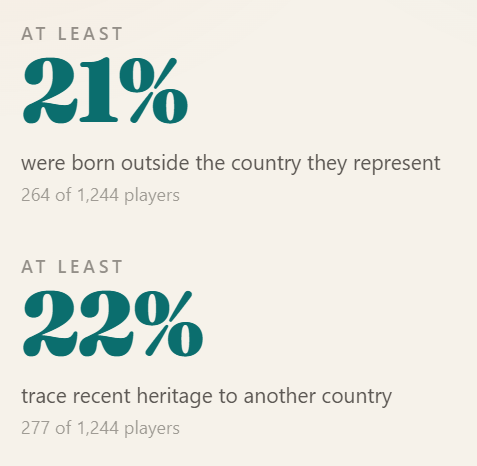
What has been frequently talked about this World Cup edition is the number of refugee and immigrant players.
Source: World Cup x Peace, Institute for Economics and Peace
“More than a third of the players at this tournament were born in, or descend from, a country other than the one they represent. Many of the players who descend from countries with low levels of peace play for more peaceful countries, as migration flows often reflect the impact of conflict on human movement.”1
In this sense, football teams tell incredible stories of migration - and peace. Such as the one of Nestory Irankunda, born as a Burundian refugee in Tanzania, defending the Australian National Team and becoming the youngest Socceroo to score at a FIFA World Cup, on June 13 against Turkey.
Irankunda's story is one example of an elite-level football player from a refugee background who “has achieved global success due to a supportive environment. This is what happens when we recognise the humanity and potential of our migrant communities.”5
But besides having to acknowledge the stories of many other successful players from refugee backgrounds6, we must advocate for football at the grassroot level, beyond elite sport.
Football has the power to unite the world and perhaps to change the world too. Football is the most popular and one of the most accessible sports; it offers a respite and lifelong lessons to children and adolescents, helping them achieve their full potential and even their dreams.
References:
- https://worldcup.economicsandpeace.org/
- https://www.visionofhumanity.org/maps/#/
- https://www.visionofhumanity.org/wp-content/uploads/2026/06/Global-Peace-Index-2026-Report.pdf
- https://www.footballpeaceacademy.com/blog-1/the-largest-most-fearsome-world-cup-so-far
- https://www.linkedin.com/posts/tasneemchopra_multiculturalaustralia-refugeeweek-identity-share-7471924645324050432-ctC0/?utm_source=share&utm_medium=member_desktop&rcm=ACoAACMJrh8B1jdOuqg9ZyCN_Q69c3cFaYRecZ4
- https://www.instagram.com/p/DYgtcQ6ol1K